Investment CoursesZTE Rises Over 6% as Strategic Partnership with Tencent Fuels AI Cloud PC Ambitions and AI Agent Commercialization Prospects
On June 4, Hong Kong-listed telecommunications equipment and AI-related stocks traded actively, with ZTE Corporation (00763.HK) extending its gains during the session. As of publication, ZTE shares were trading at HK$28.60, up 6.08%, with turnover reaching HK$835 million. The stock earlier climbed to an intraday high of HK$29.12, marking its highest level in recent months.
Investor sentiment was boosted after ZTE announced a deep strategic partnership with Tencent Holdings. The two companies are set to jointly launch an AI cloud PC powered by Tencent’s native WorkBuddy AI agent. The announcement quickly attracted market attention and reignited discussions around the commercialization potential of AI agents.
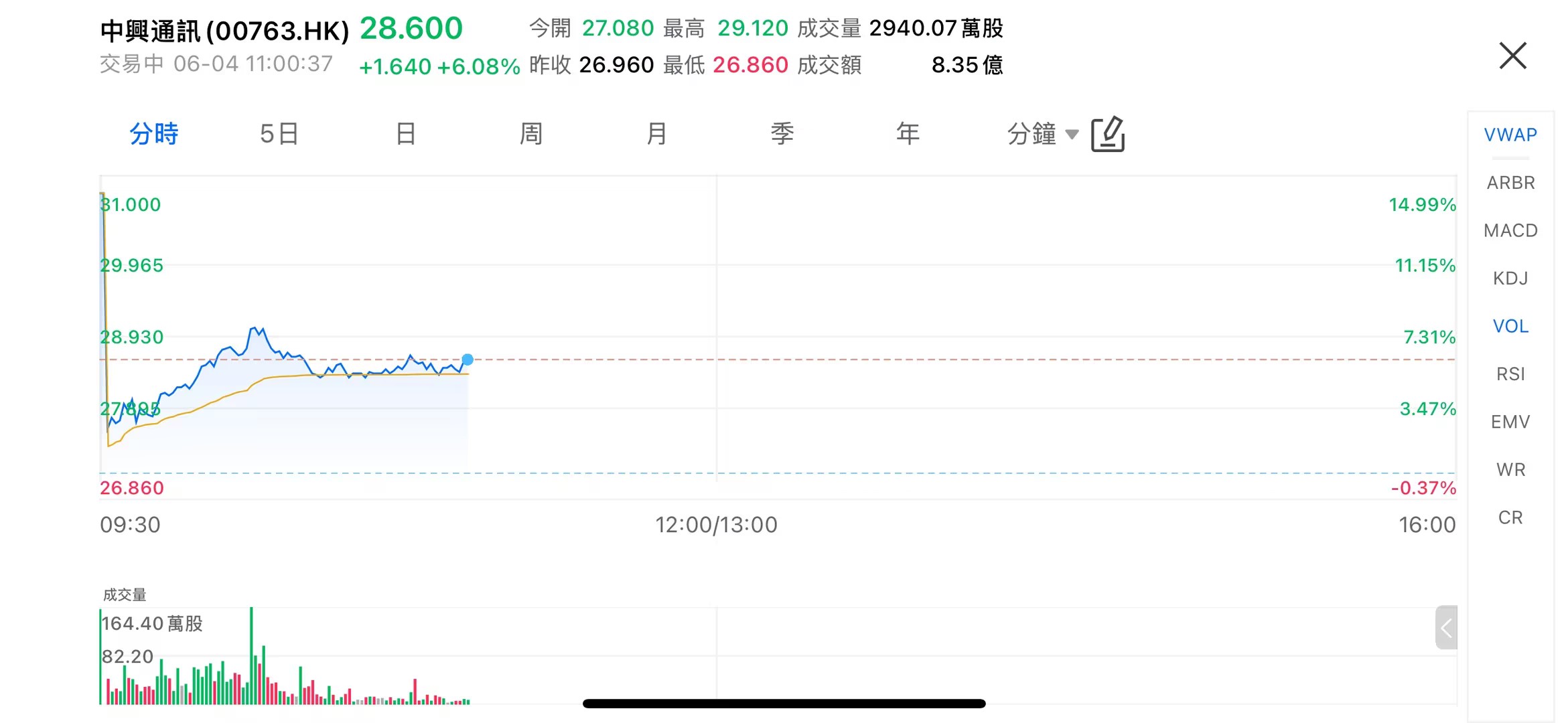
(Image Source: uSMART HK app)
AI Cloud PC Targets Productivity and Office Scenarios
According to information disclosed by both companies, the upcoming product will integrate Tencent Cloud computing resources, Tencent’s Hunyuan large language model, the WorkBuddy AI agent, and Tencent’s broader application ecosystem. The solution is designed to deliver a more intelligent productivity and collaboration experience for a wide range of users, including students, office workers, freelancers, and small business teams.
Unlike traditional personal computers that rely primarily on local hardware performance, AI cloud PCs leverage cloud-based computing power to process complex workloads. Users can access high-performance computing capabilities through lightweight devices while utilizing AI assistants to perform tasks such as document organization, meeting summarization, data analysis, and content creation.
Industry observers believe that as AI agents evolve from conversational tools into productivity-focused assistants, cloud PCs could emerge as one of the key terminal platforms for deploying AI capabilities.
From Hardware Vendor to Computing Service Provider: ZTE Accelerates AI Terminal Strategy
In recent years, ZTE has continued to advance its “Connectivity + Computing Power” strategy, increasing investments in AI infrastructure and intelligent terminal devices.
At a recent AI cloud PC showcase event, the company unveiled a portfolio of products spanning cloud laptops, AI tablets, and home terminals, while promoting its vision of “Computing Power as a Service.” ZTE believes that users will increasingly shift from purchasing hardware outright to consuming cloud-based computing resources on demand.
According to company data, cumulative sales of ZTE cloud terminals have surpassed 2 million units, ranking among the leading cloud terminal vendors in China for two consecutive years. As demand for AI computing resources continues to grow, cloud PCs are gradually expanding beyond enterprise and government applications into the broader consumer market.
WorkBuddy Emerges as Tencent’s Key AI Commercialization Vehicle
WorkBuddy is increasingly becoming one of Tencent’s flagship products for advancing AI agent commercialization.
In late May, Tencent Cloud officially launched WorkBuddy and other enterprise-grade AI tools for global markets. Tencent has stated that competition in AI is expected to shift from model capability alone toward practical business applications, with AI agents serving as a critical bridge between users and foundation models.
The collaboration with ZTE is widely viewed as another important step in Tencent’s efforts to expand its AI ecosystem. By integrating large language models, AI agents, cloud computing infrastructure, and terminal devices, Tencent aims to accelerate the adoption of AI services among both enterprise customers and individual users.
AI Agent Competition Enters the Terminal Era
Market analysts believe that as large language models become increasingly comparable in performance, future competition will focus more on application ecosystems, user access points, and terminal deployment scenarios.
From smartphones and AI PCs to cloud PCs and other intelligent devices, technology companies are racing to establish the primary platforms through which AI agents interact with users. The partnership between ZTE and Tencent highlights the growing trend of integrating terminals, computing power, and AI agents into a unified ecosystem.
Many institutions believe that 2026 could become a pivotal year for large-scale AI agent adoption. Companies possessing advantages in cloud infrastructure, terminal hardware, and ecosystem development may be well positioned to benefit from the next phase of AI-driven industrial transformation.
How to Buy ZTE Corporation on uSMART
After logging into the uSMART HK app, click the “Search” button in the top-right corner of the page, enter the ticker code (00763.HK) , and navigate to the details page to view transaction details and historical trends. Click the “Trade” button in the bottom-right corner, select the trade type, and submit your order after filling in the transaction conditions.
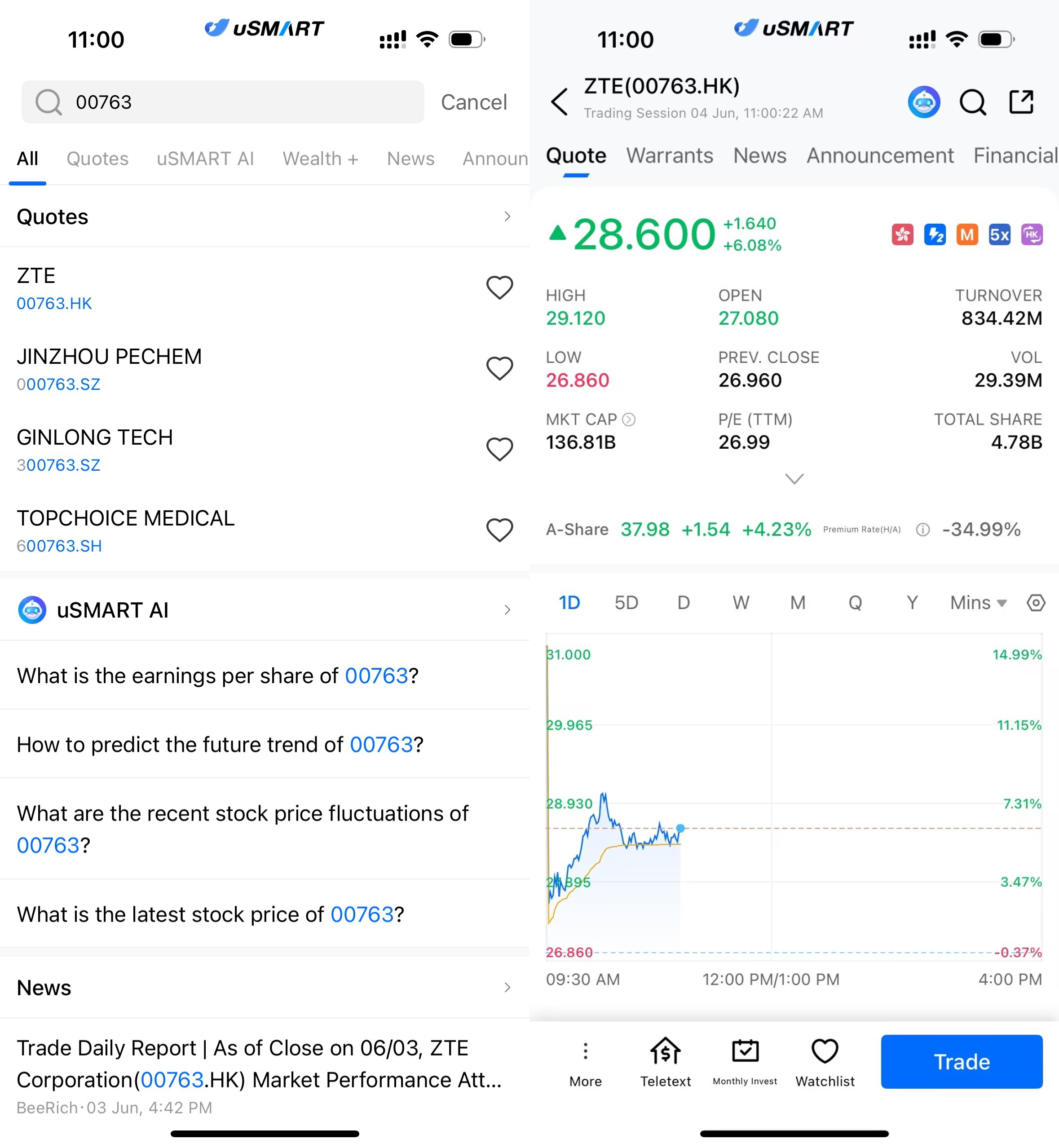
(Image Source: uSMART HK app)

More Content