Investment CoursesHong Kong Robot Stocks Surge as Physical AI Gains Momentum, Wuxi Vision Up Over 14% Amid Industry Revaluation
Hong Kong Robot Stocks Surge as Physical AI Gains Momentum, Wuxi Vision Up Over 14% Amid Industry Revaluation
On June 8, Hong Kong-listed robotics stocks rallied against the broader market trend. As of press time, Wuxi Vision (06651.HK) was trading at HK$144.90, up 14.45%, with turnover reaching HK$2.26 billion. Estun Automation (02715.HK) rose 13.22% to HK$20.56, with turnover of HK$806 million, while UBTECH Robotics (09880.HK) gained 7.07% to HK$118.10, with turnover of HK$2.40 billion. Other robotics-related names also posted solid gains, including Zeeho Motor Control (02692.HK), up 4.88%, and Roiserv Robotics (01236.HK), up 6.19%, reflecting broad strength across the robotics supply chain.
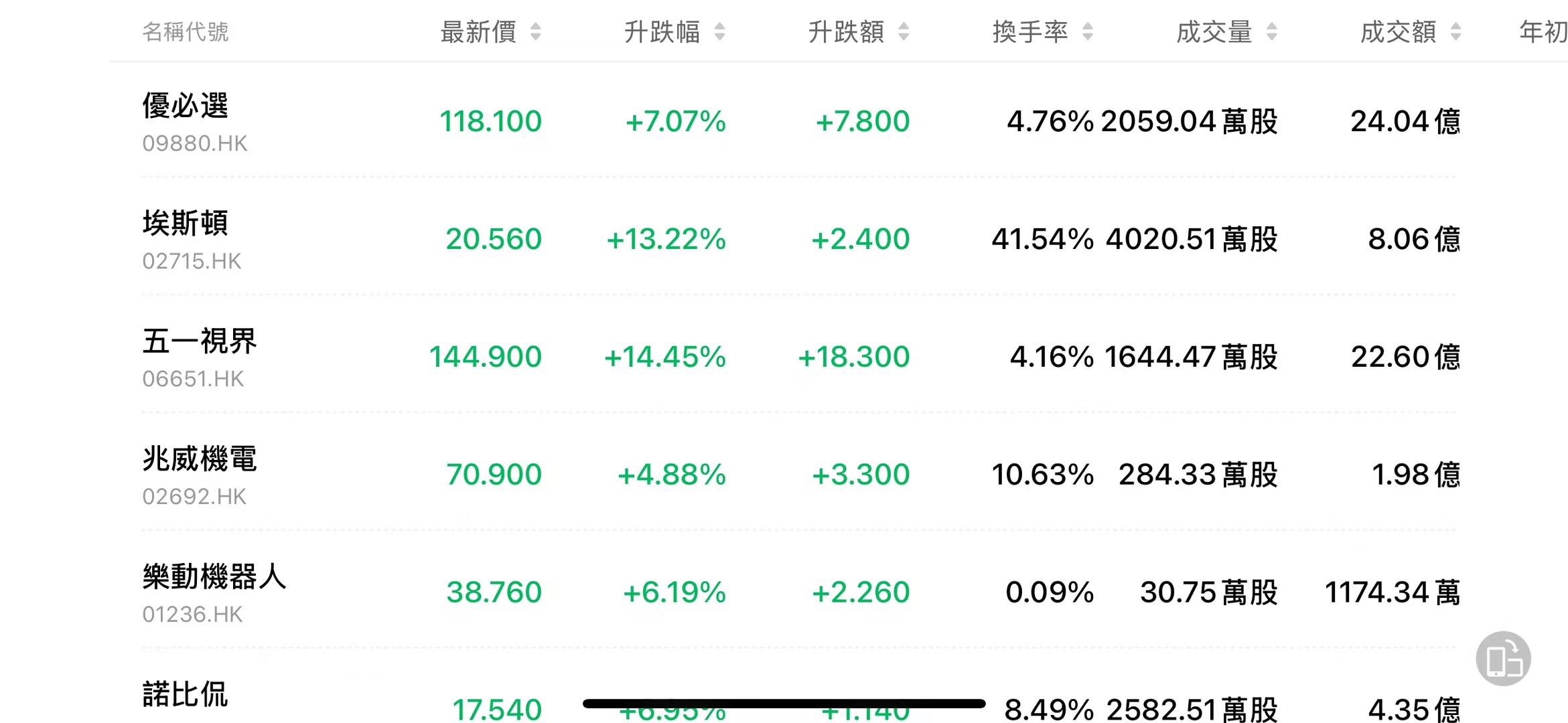
(Image source: uSMART HK App)
The latest rally in robotics stocks has been driven not only by increasing production volumes and order momentum across the industry, but also by growing global attention toward Physical AI. As large language models continue to advance, investor focus is gradually shifting from AI infrastructure and computing power toward real-world AI applications, with robotics widely regarded as one of the most important embodiments of AI in the physical world.
Tech Leaders Highlight Robotics as a Core AI Application
In recent weeks, major technology leaders have repeatedly emphasized the strategic importance of robotics and Physical AI.
During a recent event in South Korea, NVIDIA CEO Jensen Huang reiterated that robotics and Physical AI will play a pivotal role in the future of manufacturing. He noted that robots are expected to become increasingly important in semiconductor fabrication, industrial automation, and smart factory operations.
According to Huang, continued advances in AI models will significantly enhance robots’ environmental perception, decision-making, and execution capabilities, driving further productivity gains across the manufacturing sector. As one of the world's leading manufacturing hubs, South Korea is expected to see sustained demand for automation upgrades.
Meanwhile, Masayoshi Son, founder of of SoftBank Group, has also expressed strong optimism about the robotics industry. He believes that following the eras of the internet, mobile internet, and generative AI, Physical AI could become the next major technological revolution and potentially give rise to a new generation of trillion-dollar companies.
Tesla Accelerates Optimus Development as Mass Production Approaches
Beyond industry commentary, commercial progress in humanoid robotics continues to accelerate.
Market reports suggest that Tesla is speeding up preparations for mass production of its Optimus humanoid robot. Production line upgrades at the company's Fremont facility are reportedly nearing completion, and the next-generation Optimus V3 is expected to debut by the end of June.
The market generally expects the V3 version to deliver significant improvements in motion control, dexterous manipulation, and AI-powered autonomous decision-making capabilities.
As hardware performance improves and costs gradually decline, Tesla aims to scale robot production to the million-unit level over the coming years, facilitating the transition of humanoid robots from experimental prototypes to large-scale commercial products.
Given Tesla's position as a global leader in electric vehicles, each technological breakthrough in its robotics business is closely watched by investors and could create positive spillover effects across the broader supply chain, including precision components, sensors, reducers, and intelligent control systems.
Unitree Robotics Clears IPO Review, Reinforcing Industry Confidence
China's robotics industry has also reached an important milestone.
Humanoid robot developer Unitree Robotics has successfully passed its STAR Market IPO review. From application acceptance in March 2026 to approval, the process took only 73 days, setting a new speed record under the STAR Market's pre-review mechanism.
According to public filings, the company plans to raise RMB 4.202 billion to support intelligent robotics R&D, robot model training platforms, and industrialization projects.
Unitree's rapid IPO progress not only reflects regulatory support for hard-tech enterprises but also demonstrates growing capital market confidence in the commercialization prospects of the robotics industry. As more robotics companies enter public markets, financing conditions are expected to improve further, supporting accelerated technology development and capacity expansion.
Order Growth Continues as Industry Enters Mass-Production Phase
At the industry level, the robotics supply chain is showing increasingly positive signs.
Several brokerage research reports indicate that a number of key suppliers have recently received project confirmation letters and mass-production notices, with order volumes beginning to scale up. Some companies have reported sustained week-on-week increases in orders, signaling a clear acceleration in production activity.
At the same time, both domestic and international suppliers are expanding automated manufacturing lines and overseas production capacity. As production processes mature, yields improve, and supply chain coordination strengthens, robotics manufacturing costs are expected to decline further, paving the way for broader commercial adoption.
The second half of this year is widely expected to become a critical validation period for the humanoid robotics industry. Investors will closely monitor production volumes, order execution, and the expansion of end-user application scenarios as key indicators of the sector's long-term growth trajectory.
Follow us


More Content