Investment CoursesTencent Shares Surge Nearly 10% as AI Assistant Progress Boosts Market Sentiment
On June 2, Tencent Holdings Limited (00700.HK) saw its shares perform strongly in the Hong Kong market following news of progress on its AI intelligent assistant project. As of 14:22 HKT, Tencent shares were trading at HK$479.2, up approximately 9.91% from yesterday’s closing price of HK$436. The stock hit a near-term high during intraday trading, with turnover gradually increasing, reflecting heightened market expectations for Tencent’s AI initiatives.
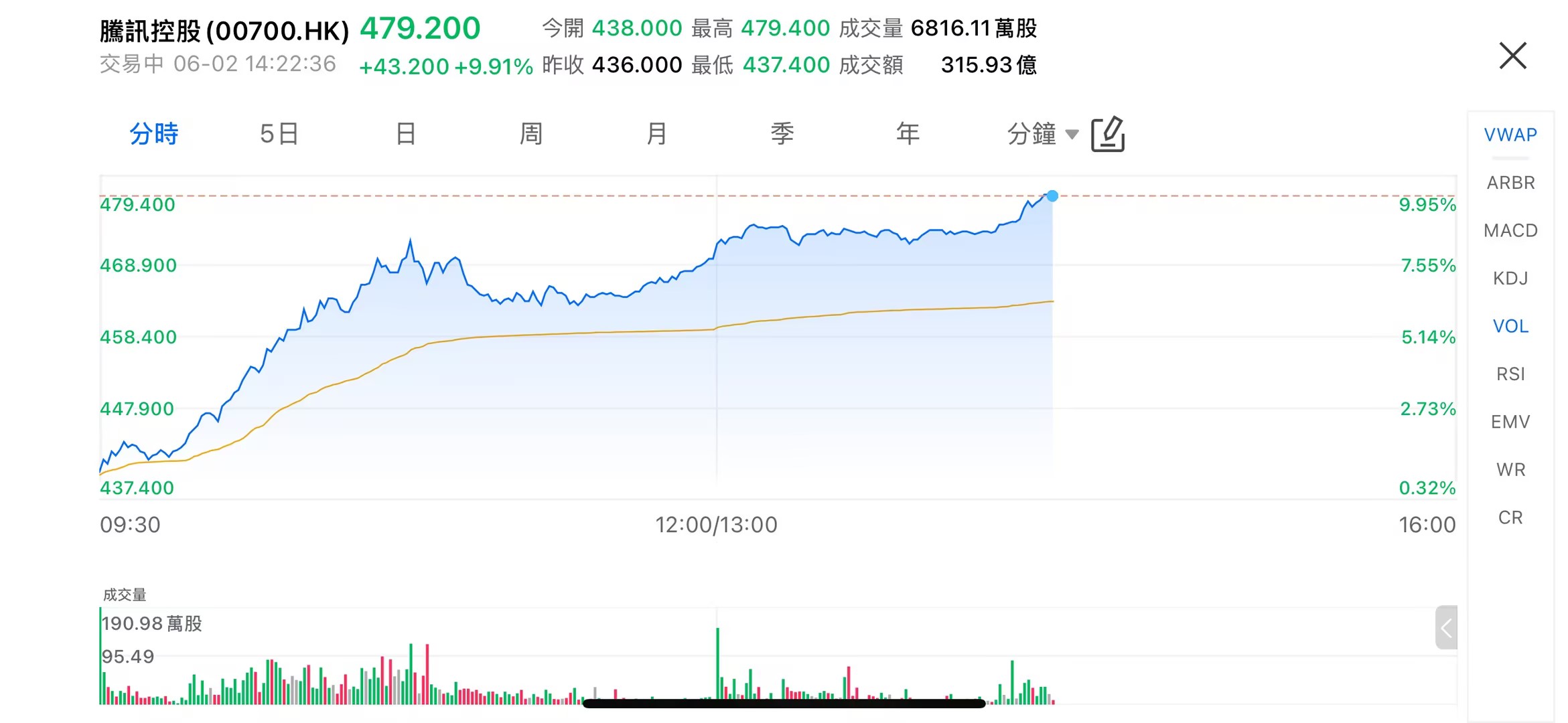
(Image Source: uSMART HK app)
AI Integration into WeChat Accelerates
According to multiple reliable sources, Tencent is speeding up plans to deeply integrate AI agents into the WeChat ecosystem. The AI assistant has completed internal prototype testing and is expected to enter the formal compliance approval process within this month. Once approved, Tencent plans to conduct gray-scale testing with a portion of external users before gradually scaling up. Although the exact launch date remains uncertain, this initiative is seen as a key move for Tencent in the generative AI sector, likely to have a significant impact on the experience and interaction patterns of over 1.4 billion WeChat users.
Distinct Advantages of Native Ecosystem Could Enable Closed-Loop AI Services
Industry observers note that compared with competitors such as Alibaba and ByteDance, WeChat holds unique advantages in deploying AI agents: A massive user base with high-frequency engagement;Mini-program ecosystem covering a full range of life services, including dining, transportation, shopping, and ticketing; Built-in payment functionality, enabling a one-stop “suggest–execute–pay” closed-loop process.
Insiders who have seen internal demonstrations indicate that the new AI assistant can be invoked directly from the WeChat main interface. Users can interact via natural language to access mini-program resources to search, book, or place orders, significantly improving efficiency and convenience.
Competition and Industry Pressure Coexist
Tencent is not the first major domestic company to focus on AI agent development. Alibaba has already integrated its Tongyi large model into e-commerce, travel, maps, and other services, while ByteDance is rapidly building intelligent-agent-based scenario services under its Doubao app. Although Doubao and Tongyi have smaller overall user bases compared with WeChat, their rapid growth is regarded as competitive pressure for Tencent.
Tencent has already deployed a chatbot named “Yuanbao” within WeChat with search capabilities, but industry consensus holds that it lacks full intelligent agent functionality. This is one of the key drivers behind Tencent’s accelerated AI agent initiative.
Challenges in Computing Power and Commercialization Cannot Be Ignored
Although the prototype version can perform tasks relatively smoothly, supporting full-scale WeChat user-level operations requires Tencent to further expand its computing infrastructure. Large-scale AI agent deployment demands substantial inference resources and incurs high costs. While the industry generally sees long-term commercial potential in AI agents, the short-term challenge of generating sufficient revenue to offset heavy computing expenses remains a key market concern.
Market View: AI Could Become a New Growth Curve
Analysts suggest that if Tencent’s AI assistant successfully integrates with WeChat’s local services and payment ecosystem, it could enhance user stickiness and usage frequency, thereby providing incremental revenue for advertising and transaction commissions. As generative AI continues to penetrate user service scenarios, WeChat’s “intelligent upgrade” may become an important driver of Tencent’s valuation recovery.
How to Buy Tencent on uSMART
After logging into the uSMART HK app, click the “Search” button in the top-right corner of the page, enter the ticker code (00700.HK) , and navigate to the details page to view transaction details and historical trends. Click the “Trade” button in the bottom-right corner, select the trade type, and submit your order after filling in the transaction conditions.
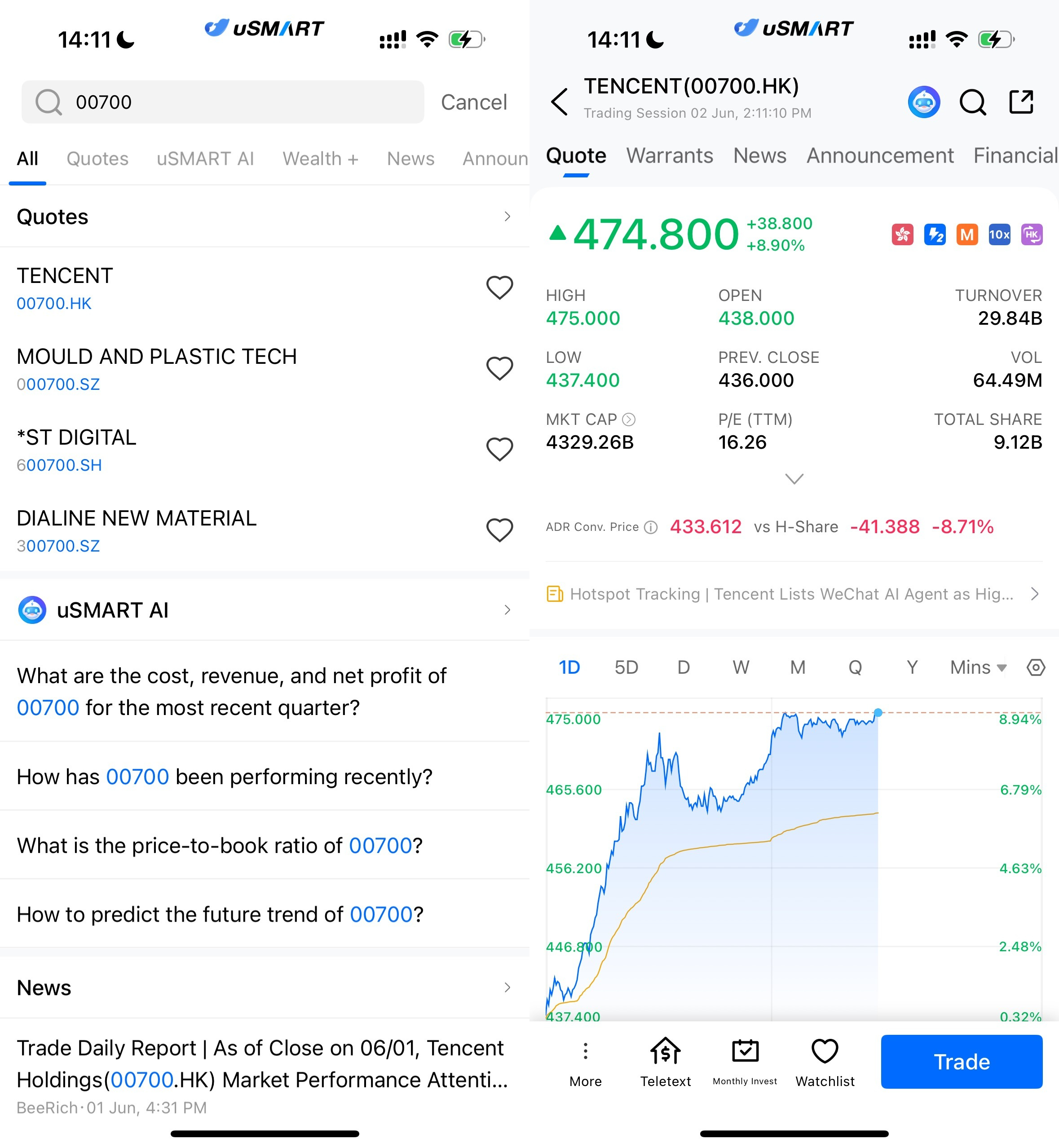
(Image Source: uSMART HK app)


More Content