You are browsing the Hong Kong website, Regulated by Hong Kong SFC (CE number: BJA907). Investment is risky and you must be cautious when entering the market.
uSmart Securities Limited is a corporation licensed by the Hong Kong Securities and Futures Commission (CE No.: BJA907) and is authorised to carry on Type 1 (Dealing in Securities), Type 2 (Dealing in Futures Contracts), Type 4 (Advising on Securities), Type 5 (Advising on Futures Contracts), Type 6 (Advising on Corporate Finance) and Type 9 (Asset Management) regulated activities.
An Equity-Linked Investment (ELI) is a structured investment product with derivative features, linked to one share or a basket of shares. Its potential return, any early redemption and settlement at maturity depend on the performance of the underlying shares and the product terms.
How share prices and product terms affect the outcome
When comparing ELIs, consider the underlying shares, coupon, strike price and investment period. Depending on the structure and market performance, you may receive coupon payments and repayment in cash, or receive shares at maturity. The outcome remains subject to the product terms and the issuer’s ability to meet its obligations.
How does a Fixed Coupon Note (FCN) relate to an ELI?
A Fixed Coupon Note (FCN) is a common type of ELI. It pays coupons at a fixed rate, on the dates and subject to the conditions set out in the product terms. Some FCNs may be redeemed early if the relevant autocall conditions are met. A fixed coupon does not guarantee a profit. Your overall return also depends on the investment period and the settlement outcome. If shares are delivered, a fall in their value may exceed the coupons received.
Potential benefits and key risks of Equity-Linked Investments (ELI)
Potential Benefits – Potential For Higher Coupon
Returns
In favourable market conditions, an ELI may offer the potential for higher returns through coupons.
Potential Benefits – Access For Retail Investors
Certain products may be available to investors who are not classified as professional investors, subject to eligibility and suitability
requirements.
!
ELIs involve investment risk. Unless the specific product documents expressly state otherwise, they are not principal-protected. Read the product terms and risk disclosures before subscribing.
FCN (NVDA + GOOGL)
Illustrative Fixed Coupon Note • 6-month tenor
Investment amountUS$10,000
Coupon18% per annum
Tenor6 months
Strike80%of each share’s initial price.
Term
Illustrative assumption
Underlying shares
NVIDIA Corporation (NASDAQ: NVDA) and Alphabet Inc. Class A (NASDAQ: GOOGL).
Investment amount
US$10,000.
Initial share price
100%.
Coupon
18% per annum
Tenor
6 months.
Strike
80% of each share’s initial price.
Knock-Out (KO)
105% of each initial price; observed monthly.
Knock-In (KI)
None.
Worst-of & maturity
The share with the lower percentage performance versus its own initial price is the worst-of. If it ends at or above 80%, principal is repaid in cash. If it ends below 80%, the investor receives shares of the worst-of, calculated using the 80% strike, or the cash equivalent if the final terms provide for cash settlement.
Coupon illustration: US$10,000 × 18% × 6/12 = US$900 over six months (about US$150 per month). If the note is called in month 3, assume three monthly coupons of US$450 in total; no further coupons accrue after redemption.
Illustrative outcomes
Scenario 1
KO in month 3
Value at redemption / maturity
US$10,450
Both shares close at or above 105% of their initial prices on a monthly observation date.
principal
US$10,000
coupons
US$450
Scenario 2
Maturity;
worst-of 90%
Value at redemption / maturity
US$10,900
No KO. The worst-of finishes at or above the 80% strike.
principal
US$10,000
coupons
US$900
Scenario 3
Maturity;
worst-of 72%
Value at redemption / maturity
US$9,900
No KO. The worst-of finishes below the 80% strike; shares are valued at 72% of initial price.
share value
US$9,000
coupons
US$900
72% worst-of: approximate loss calculation Share value at maturity: US$10,000 × (72% ÷ 80% strike) = US$9,000. Paper loss versus the strike-based share value: US$1,000, or about 10% of the original investment, before coupons. After the assumed six-month coupons of US$900: approximate net loss of US$100, or 1% of the original investment, before fees and taxes.
Illustration only, not an offer or final term sheet.
!Fixed Coupon Rates Do Not Guarantee Principal Protection
FCNs are not principal-protected products and may not be suitable for all investors. Investors should carefully consider risks including declines in the value of underlying assets, issuer credit risk, early redemption risk and liquidity risk.
How to invest in ELIs through the uSMART App
Before subscribing, review the product terms, assess the risks and check the transaction details.
STEP 01
Open the
ELI market
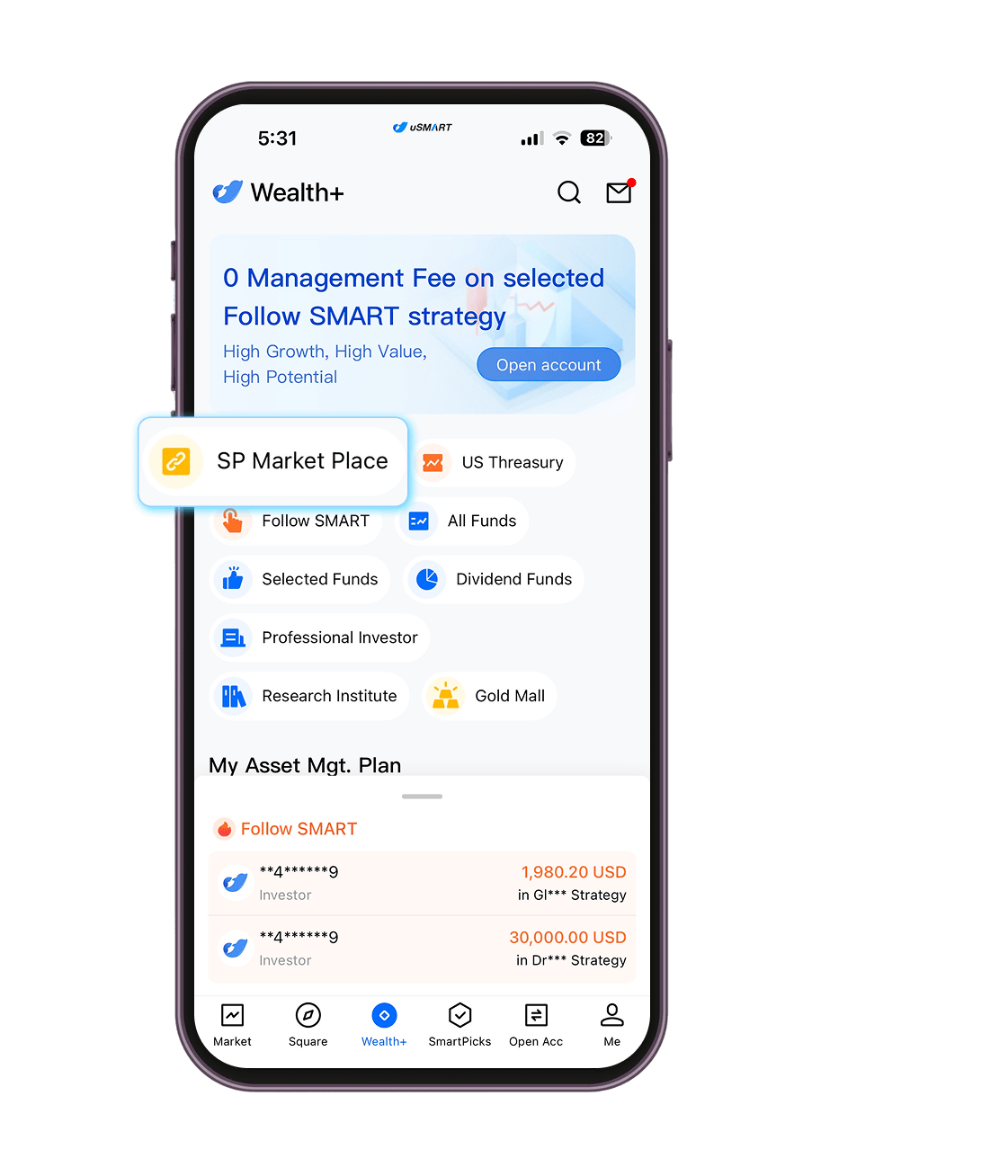
Sign in to the uSMART App. Tap “Wealth”, then select “ELI Market”.
STEP 02
Choose
a product
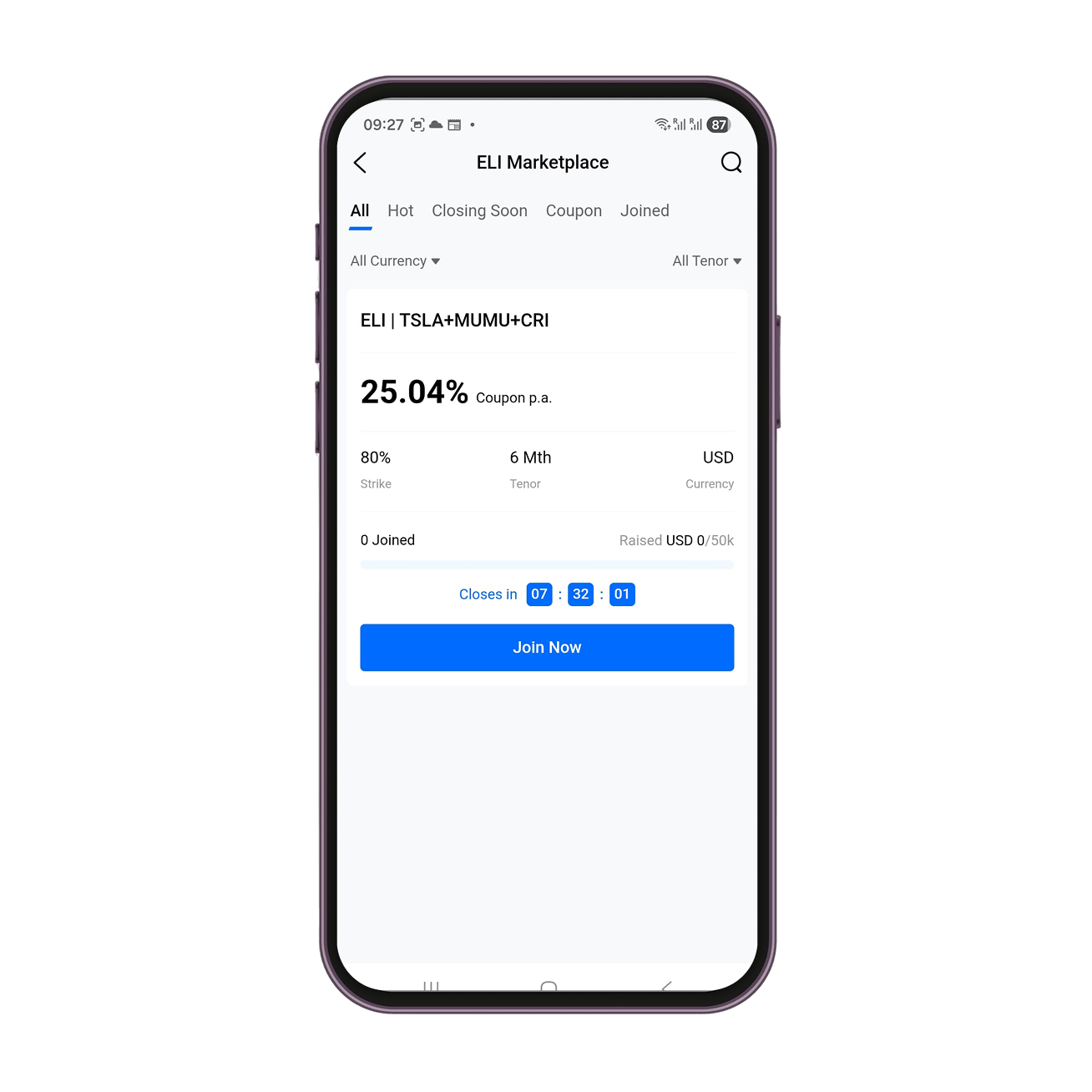
Browse the ELI market and select a product or underlying basket that interests you.
STEP 03
Review
the details
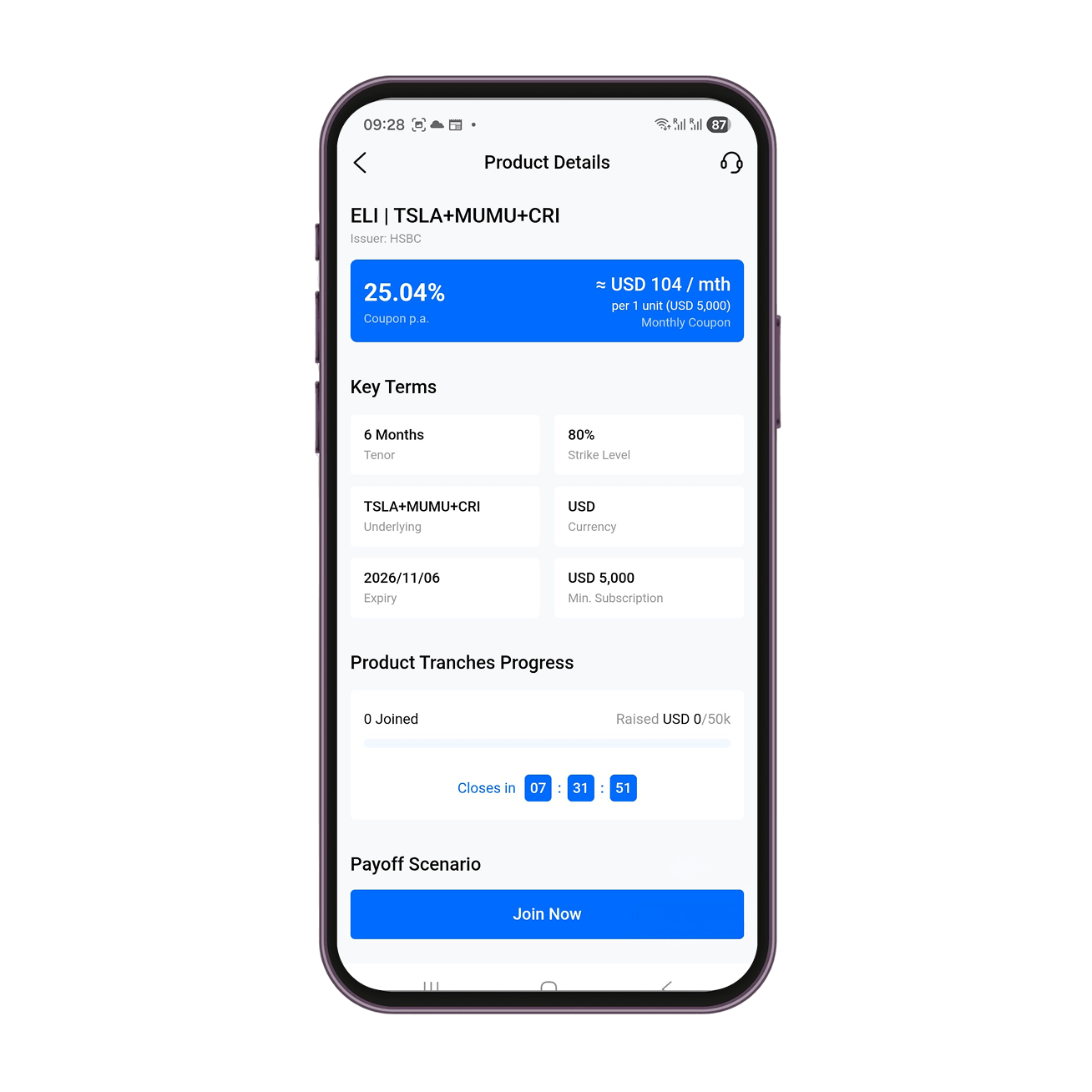
Check the coupon, investment period, strike price and settlement terms on the product details page.
STEP 04
Confirm
and submit
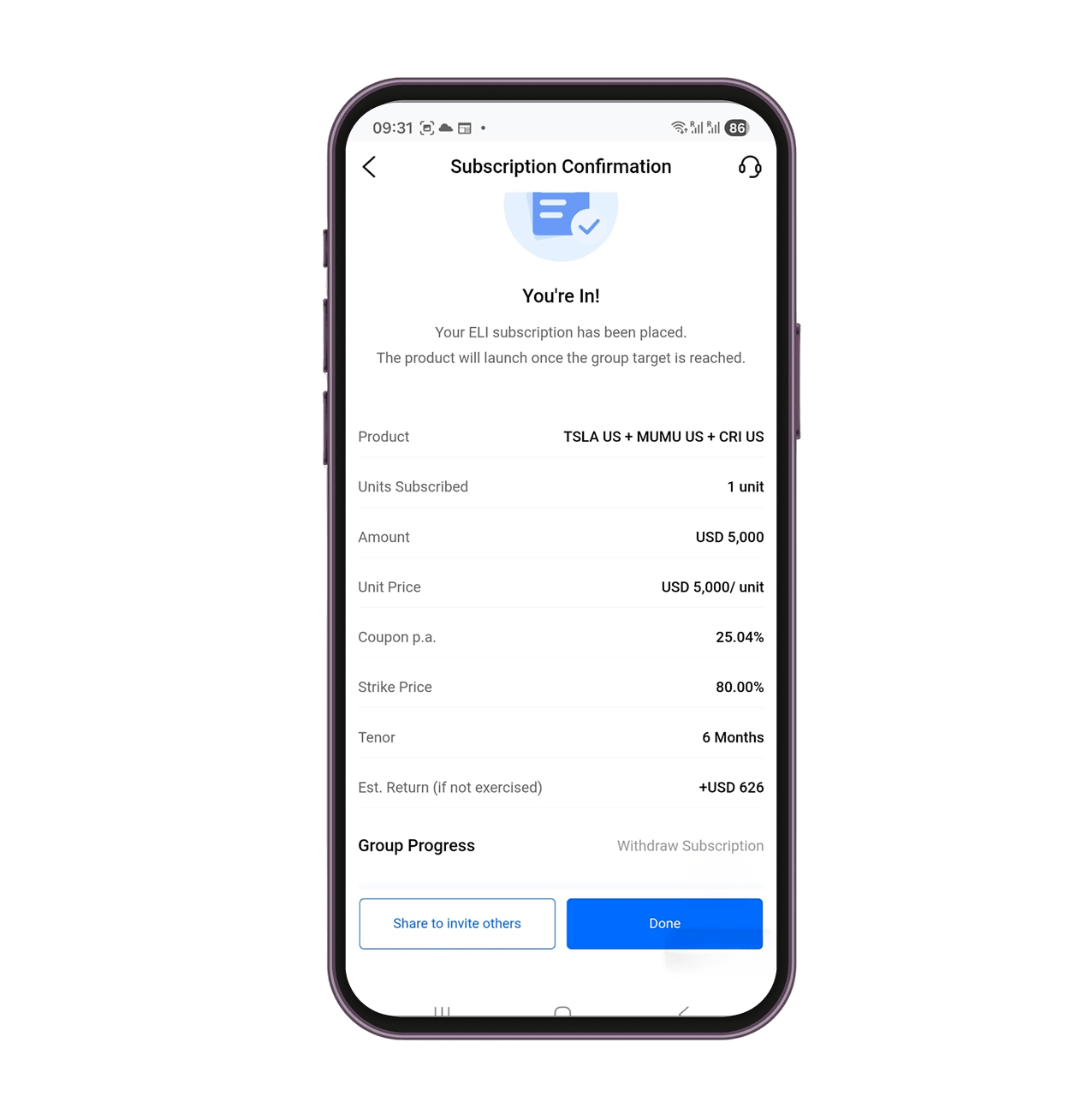
Choose the subscription quantity, check the amount, review the risk disclosure and tap “Confirm Subscription” to submit your request.
The app screens shown in the source are for illustration only and do not show a live transaction. The entry point and steps in the App may vary. Arrangements confirmed by a relationship manager may also differ.
Make sure you understand how the ELI works, including its underlying shares, investment period, coupon and settlement terms. Before subscribing, consider whether the product is suitable for your investment objectives, financial position and risk tolerance. If you have questions, speak to a uSMART relationship manager.
How is an ELI different from buying shares directly?
An ELI is a structured investment product linked to share performance and may pay coupons in line with its terms. It does not give you direct ownership of the underlying shares. As an ELI investor, you generally do not have shareholder rights during the investment period.
Is my principal protected? Does a fixed coupon guarantee a profit?
The non-principal-protected ELIs described here do not guarantee repayment of your principal. A fixed coupon does not guarantee a profit. If the underlying share falls, you may incur a loss if the ELI settles in shares, and coupons already received may not offset that loss. You are also exposed to the issuer’s credit risk. In the worst case, you could lose your entire investment.
Are coupon payments made every month?
That depends on the individual product. The coupon amount, payment dates and any payment conditions are set out in the relevant product documents.
Can I exit my investment before maturity?
There may be no active secondary market for an ELI before maturity, so you may not be able to sell it early. If an early sale is possible, you may receive significantly less than your original investment. Before subscribing, check the tenor, early-exit arrangements and any applicable fees.
Will I receive cash or shares at maturity?
Whether you receive cash or shares depends on the underlying share’s performance and the product terms. The ELI may be cash-settled or settled by physical delivery of shares. If shares are delivered, their market value at that time may be lower than your original investment.
What do the strike price, knock-in level and knock-out level mean?
The strike price is used under the product terms to determine settlement at maturity, such as the number of shares delivered. The knock-in level is the specified price used to determine whether a knock-in event has occurred. Whether shares must be accepted also depends on the other product terms and the final share price. For a product with a knock-out or autocall feature, it may be redeemed early if the relevant conditions are met on an observation date.
What is the minimum investment? Can non-professional investors take part?
Some publicly offered retail ELIs may have minimum subscription amounts as low as US$5,000 or HK$10,000, depending on the issuer and product terms. The actual minimum may also depend on the underlying share price, issuer terms, trading currency and subscription channel. Some OTC or more complex products may require a higher minimum. Whether a non-professional investor can participate depends on the specific product’s eligibility requirements and suitability assessment.
How can I check ELI products and trading arrangements?
To ask about available ELI products or trading arrangements, contact a relationship manager through the uSMART App. Use the contact channel shown in the App. Make sure you understand the product terms and risks before deciding whether to participate.
Risk disclosure and disclaimer
ELIs are complex derivative products and may not be suitable for every investor. They are not principal-protected. In the worst-case scenario, you could lose 100% of your initial investment. If the issuer or guarantor becomes insolvent or fails to meet its payment obligations, you may not receive coupon payments or repayment of principal. You may also not receive a cash settlement amount that you might otherwise have expected.
There may be no secondary market for an ELI before maturity, so you may be unable to sell it early. An early sale, if available, may result in a loss. Structured-product prices can rise or fall, and past performance is not a guide to future returns. Actual returns and settlement depend on the product terms, market conditions and the issuer’s ability to meet its obligations.
The scenarios on the source webpage are for illustration and educational purposes only. They may not cover every term of an actual product and do not guarantee investment results. The webpage is not an offer, solicitation, recommendation or investment advice. Before investing, read the final offering documents and term sheet. Consider whether the product is suitable for your investment objectives, financial position and risk tolerance. Where appropriate, seek independent professional advice.
The source webpage states that its content has not been reviewed by the Securities and Futures Commission (SFC). The final offering documents and term sheet govern the product terms, investor eligibility and minimum subscription amount. Read the relevant documents and, where appropriate, seek independent professional advice.