Investment CoursesWhat Is US Options Premarket Trading? 4 Things Hong Kong Investors Should Know First
What Is US Options Premarket Trading? 4 Things Hong Kong Investors Should Know First
US options premarket trading moves the tradable window earlier, before the US open, so Asian investors can react to earnings and news during local daytime. This article explains what premarket options are, how the hours map to Hong Kong time, common use cases, and key rules such as limit orders and symbol coverage—so you can set the right expectations before deciding whether to take part.
For Asian investors, the regular US equity session often falls in the middle of the night locally. Stocks have long had relatively mature premarket trading, but single-stock / ETF options were for a long time mainly available during regular trading hours in Eastern Time (typically 9:30–16:00). As the market extends trading hours for some options, Hong Kong investors get a chance to participate during local daytime and react more quickly to premarket earnings and news. The starting point is understanding the rules—not slogans about “staying up later” or “24×7 trading.”
Below we cover four points—what it is, when you can trade, which scenarios fit, and order boundaries—then briefly explain how to use it on uSMART, with learning-focused FAQs. If you are still new to Calls and Puts, start here: Options basics, What are options.
1. What is US options premarket trading?
US options premarket trading means buying and selling single-stock or ETF options in an extended session before the open, outside regular options trading hours.
It is not the same as “stock premarket”:
| US stock premarket | US single-stock / ETF options extended hours | |
| Adoption | Already common | Relatively newer (selected underlyings rolled out over time) |
| Coverage | Broader set of tradable stocks | Usually only some high-liquidity underlyings |
| Typical use | Price discovery around news and gaps | Directional views, hedging, or restructuring with options |
At the exchange level, for example, the Cboe Options Exchange (C1) has SEC approval to offer extended trading for eligible multiply listed equity options: premarket Global Trading Hours (GTH) run 07:30–09:25 ET, plus a short post-close Curb session (16:00–16:15 ET). Eligible options must meet volume, underlying market-cap, and underlying turnover thresholds, and there is a cap on how many classes can be included—so not all options trade in extended hours.
Important distinction: the exchange’s published window can differ from the hours and symbol list your broker actually opens to clients. Always follow what the App shows (see point 4 and the product page below).
2. Which “hours table” should Hong Kong investors use?
Keep two tables in mind: the exchange mechanism, and the hours your account can actually trade.
A. Exchange example (Cboe selected equity options GTH)
| Session | Eastern Time |
| Premarket GTH | 07:30–09:25 |
| Regular RTH | 09:30–16:00 |
| Post-close Curb (partial) | 16:00–16:15 |
B. uSMART client premarket window (product page / App prevails)
Per uSMART’s current product description, the client-facing premarket window is 04:00–09:30 ET, which in Hong Kong time is roughly:
| Hong Kong time | Eastern Time | |
| Daylight saving | 16:00–21:30 | 04:00–09:30 |
| Standard time | 17:00–22:30 | 04:00–09:30 |
DST / standard-time switches follow US official announcements and what the App displays.
Full details and steps: US options premarket trading.
For Hong Kong users, the practical point is simple: you are more likely to handle US options activity in local daytime / early evening around after-work hours, instead of sitting through the whole regular session overnight.
3. When might this be useful?
Premarket is not an “upgrade for everyone” over the regular session. It is an extra window that is often news-heavy and thinner in liquidity. Common ideas include:
1) Reacting to premarket earnings or macro data
Many US companies report before the open; CPI, nonfarm payrolls, and similar releases often land in the early Eastern morning. If options are already tradable premarket, investors can in principle adjust directional exposure or hedges before the 9:30 open—rather than only watching the stock’s premarket quote and waiting.
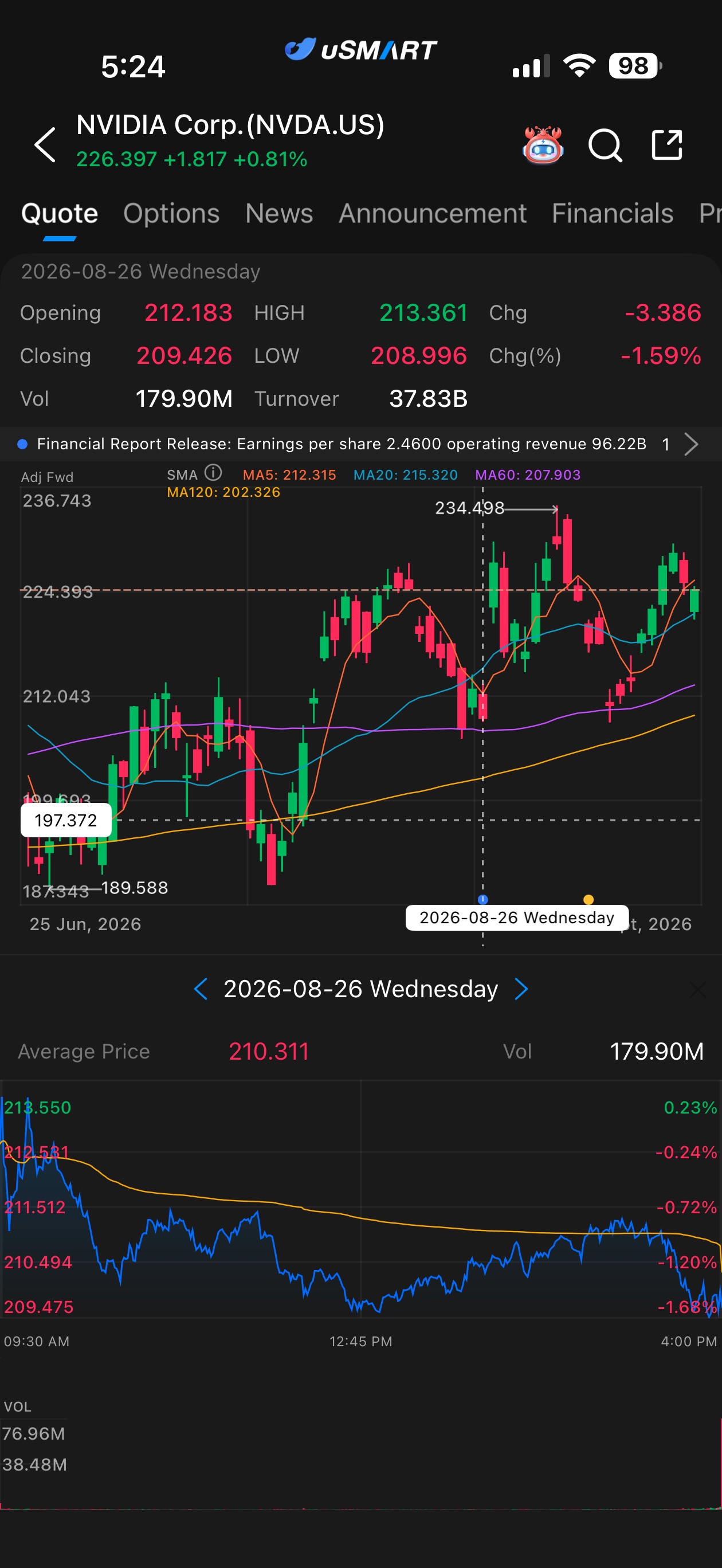
Take a heavily watched name such as NVDA: earnings and guidance can quickly reset pricing expectations. On 26 August 2026, NVIDIA released FY2027 Q2 results and related public information; around “mega-cap tech earnings days,” both the stock and options pricing are usually more sensitive. If you already hold the stock or options, premarket / pre-open swings raise the pressure on whether to hedge or reduce size. Whether to use options, and Call vs Put, depends on your position, risk tolerance, and view on volatility.
For more on “earnings + options” logic: Earnings season shocks—how can options help?
2) Risk buffering before a gap
If you already hold stock or options and clear negative or positive news hits premarket, the open often gaps. Some investors consider limited-loss hedges with options (for example buying Puts as protection) or adjusting existing structures. Spreads are often wider premarket—“wanting a hedge” and “accepting the hedge cost” are not the same thing.
3) Time-zone fit: an Asian daytime participation window
For Hong Kong and broader APAC investors, the premarket window sits closer to local daytime, so you can follow overnight US news in normal waking hours instead of compressing every decision into the regular overnight session.
4. Three boundaries to accept before you place an order
Getting expectations right matters more than any marketing line:
- Only some underlyings Extended hours usually focus on high-liquidity, large-cap–related options; follow the App display.
- Premarket typically accepts limit orders only Market orders and some smart / conditional orders are usually unavailable premarket. When liquidity is thin, a limit far from the market may sit unfilled for a long time.
- Whether orders carry into the open depends on the rules
Please note that pre-market order rules for US stock options are not cast in stone; instead, they are fully determined by the user. uSMART currently supports three session modes:
- Pre-market Only: Orders are matched exclusively during the pre-market session. Any unfilled orders will automatically expire before the regular market opens and will not carry over to the regular trading hours (RTH).
- Regular Trading Hours (RTH) Only: Execution is strictly limited to regular trading hours.
- Pre-market + RTH: Orders are valid across multiple sessions. Any unfilled pre-market orders will automatically carry over to the regular session to remain queued for matching.
There is no need for investors to get bogged down by the underlying permissions of various global exchanges. Simply select the corresponding session in the App based on your own trading strategy.
Also, premarket prints often do not carry the same “day high/low / some market-data stats” meaning as regular-session trades (exchanges often mark extended-hours prints separately). A practical mindset: price discovery is incomplete, and slippage / spread risk is higher.
How to use it on uSMART?
uSMART Securities already offers US options premarket-related services to eligible accounts. If your account already has US options permissions, you generally do not need a separate signup to participate. Premarket fees are usually aligned with regular hours; see the App fee page for details.
Which US options can I trade in premarket on uSMART?
uSMART covers the most actively watched US options across key sectors such as technology, financials, and consumer, to support a diversified strategy. Underlyings currently supported for premarket trading include:
- Semiconductors / chips: NVDA, AMD, INTC, QCOM, MU, TSM, AVGO, ASML, MRVL, SMCI, WDC, LITE, SNDK, AMKR, LSCC, TER, ON
- Tech giants: AAPL, MSFT, GOOGL, GOOG, META, AMZN, NFLX, ORCL, CRM, ADBE, PLTR, APP, SPCX
- Index ETFs: SPY, QQQ, DIA, IWM, TQQQ
The list may change from time to time. Please check the "premarket supported" label on each underlying's detail page in the App.
Before you trade, confirm yourself:
- Whether the underlying shows premarket support
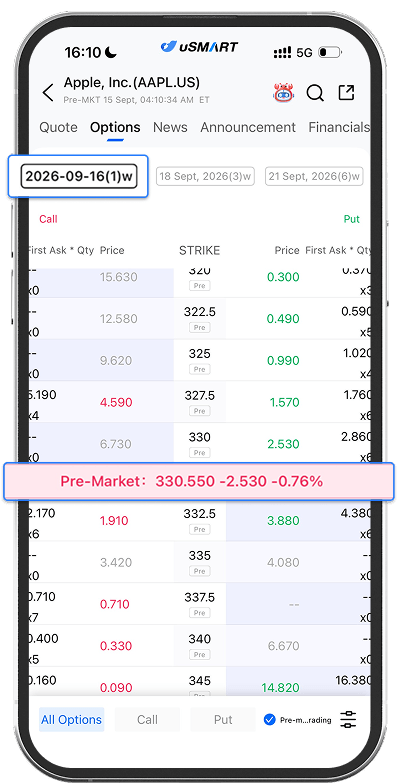
- Whether you are currently in a tradable session
- Whether only limit orders can be submitted
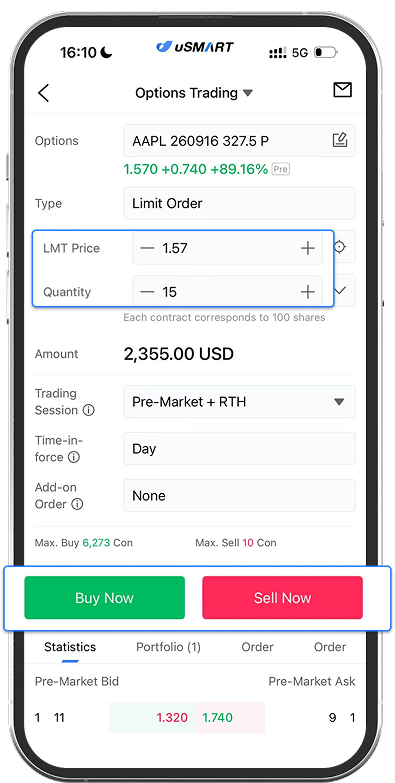
- How unfilled orders are handled before the open
Steps and full underlying coverage are on the product page:
US options premarket trading|Product overview
Permissions and regular options overview: US options trading
US options premarket: which brokers actually support it?
| Item | uSMART | Broker A | Broker B | Broker C | Broker D | Broker E |
|---|---|---|---|---|---|---|
| ① Single-stock / ETF options premarket | Yes | No | No | Yes | Yes | No |
| ② Open and close positions in both premarket and regular hours | Yes | No | No | No | No | No |
More learning content: Insights column
FAQ
Q1: What is US options premarket trading?
Trading single-stock / ETF options in an extended premarket session outside regular options hours (typically 9:30–16:00 ET). Unlike long-established stock premarket, equity options extended hours are still relatively new and usually cover only some high-liquidity underlyings.
Q2: What hours apply for Hong Kong investors?
Separate two layers: an exchange GTH example for selected equity options is 07:30–09:25 ET; uSMART’s client premarket window follows the product page / App, currently described as 04:00–09:30 ET (about 16:00–21:30 HKT in daylight saving, 17:00–22:30 HKT in standard time). DST switches follow US announcements and the App display.
Q3: What are the premarket order limits?
Premarket generally accepts limit orders only—not market orders and similar types. Premarket liquidity is often thinner than RTH, so spreads may be wider.
Q4: What use cases fit?
Common ones include reacting to premarket earnings or macro data, assessing hedges or adjustments before an opening gap, and participating in an Asian daytime time zone. Whether it fits you depends on your positions, experience, and risk tolerance.
Q5: Do I need a separate account to use premarket?
If your account already has US options permissions, you can generally participate directly (account permissions prevail). For feature details, symbol lists, and steps, see the product page.
Q6: Can I close an options position opened in premarket during regular hours?
Yes. uSMART lets you open and close US single-stock and ETF options positions in both premarket and regular hours. For example, you can open in premarket and close during the regular session, or open during regular hours and close in the next day's premarket. Among the brokers compared in this article, uSMART is the only one that supports this. Premarket liquidity is usually thinner and spreads may be wider, so limit orders are recommended. This content is for reference only and is not investment advice.
Risk disclosure
Trading options involves a high degree of risk. You may lose more than your initial margin. In volatile markets, orders may not be executed. Before trading, you must fully understand how options work, especially procedures and obligations at expiration and when exercising.
About the author|Xiao Li
Seasoned financial writer. Focuses on clear investor education and market-structure explainers, with a long-term aim of financial freedom.
Follow us


More Content