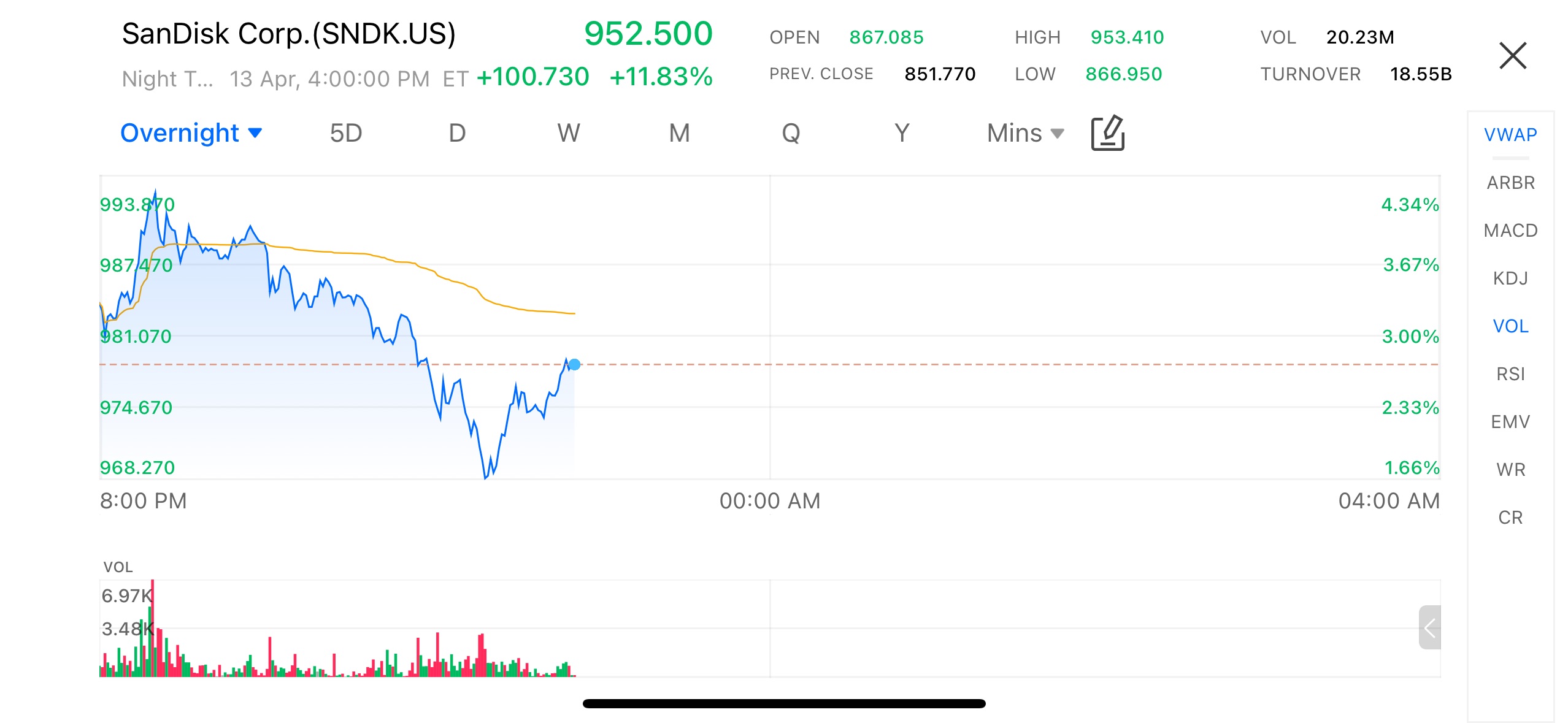
On April 13, shares of storage manufacturer SanDisk (SNDK.US) continued to strengthen. As of the time of reporting, the stock was trading at USD 952.50, up 11.83%, with an intraday high of USD 953.41 and a trading volume of USD 18.55 billion, reflecting significantly increased market activity. Notably, the stock has gained over 300% year-to-date, emerging as one of the best-performing tech stocks in the U.S. market amid AI-driven growth and a recovering industry environment.
 (Image Source: uSMART HK app)
Inclusion in Nasdaq-100 Index Provides Key Funding Catalyst
On the news front, Nasdaq announced that it will adjust the Nasdaq-100 Index components before the market opens on April 20, 2026, with SanDisk replacing Atlassian to officially join the index. As one of the most representative technology stock indices globally, the Nasdaq-100 corresponds to a massive pool of passive investment capital.
Market consensus suggests that following the index adjustment, ETFs and passive funds tracking the index will rebalance their holdings, thereby providing incremental capital support for SanDisk. Additionally, inclusion in a major index enhances the company’s visibility in global capital markets, attracting more long-term institutional investors. Historically, stocks added to core indices often experience short-term improvements in liquidity and an upward adjustment in valuation benchmarks, expectations that are reflected in the current stock performance.
HBF Technology Deployment Positions SanDisk for Next-Generation AI Storage
On the industry front, SanDisk is accelerating its deployment of High-Bandwidth Flash (HBF) technology. The company has begun collaborating with materials, component, and equipment suppliers to build an HBF prototype production ecosystem, with plans to launch prototype products in the second half of this year.
According to current plans, the pilot production line is expected to be completed and operational in the second half of 2026, targeting commercialization in 2027. Industry observers believe that HBF could become a key storage solution in the AI era, offering potential advantages in bandwidth, power consumption, and integration, complementing HBM in data center and high-performance computing applications. With AI computing demand continuing to rise, storage architecture is undergoing a new round of upgrades. SanDisk’s early HBF deployment positions it at the forefront of next-generation storage technology competition and opens up new long-term growth potential.
AI-Driven Demand Reshapes the Industry, Performance Upside Continues
From an industry fundamentals perspective, AI has become the core driver of storage demand growth. As the scale of large model training and inference expands, the need for data storage and retrieval rises sharply, elevating storage from a traditional supporting role to a critical infrastructure component.
In this context, the storage industry’s supply-demand balance continues to improve, with prices gradually recovering, driving earnings recovery for manufacturers. As a key market participant, SanDisk benefits from both expanding demand and price improvement, strengthening its profitability and cash flow performance. Market expectations for sustainable earnings have risen accordingly. Some institutions believe that AI-driven demand growth may reduce the traditional cyclical volatility of the storage industry, gradually transforming it toward structural growth.
How to Buy SanDisk on uSMART
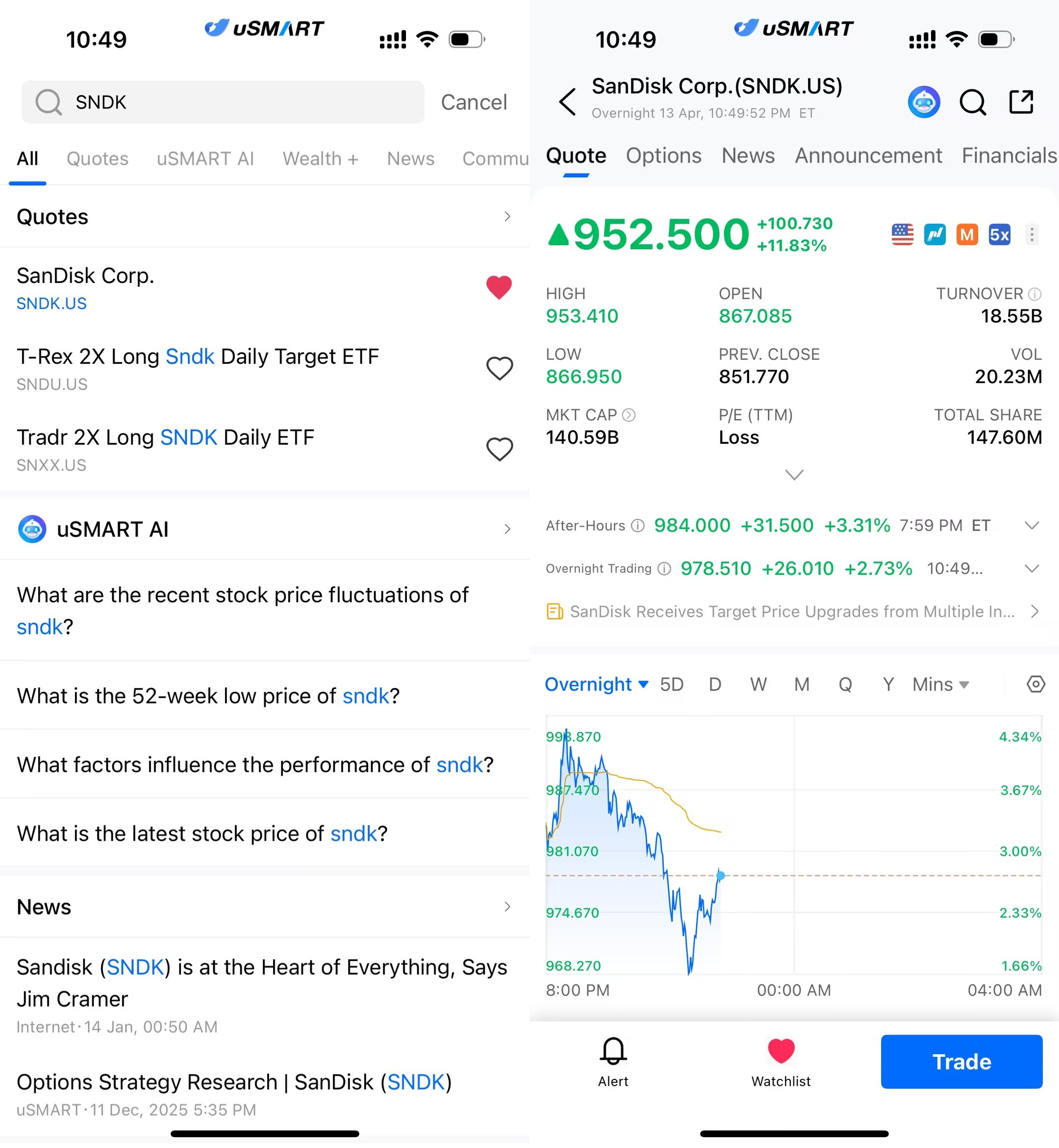
After logging into the uSMART HK app, click the “Search” button in the top-right corner of the page, enter the ticker code (SNDK.US), and navigate to the details page to view transaction details and historical trends. Click the “Trade” button in the bottom-right corner, select the trade type, and submit your order after filling in the transaction conditions.
(Image Source: uSMART HK app)


More Content