Investment CoursesHong Kong Semiconductor Stocks Rally Against Market Weakness as Memory Chip Momentum Builds; GigaDevice Hits Record High
Hong Kong Semiconductor Stocks Rally Against Market Weakness as Memory Chip Momentum Builds; GigaDevice Hits Record High
On May 20, Hong Kong-listed semiconductor stocks advanced against a broader market downturn, with multiple chipmakers seeing notable gains and higher trading volumes during intraday trading. As of writing, GigaDevice Semiconductor Inc. (03986.HK) traded at HK$705, up 17.11%, hitting a fresh all-time high intraday. Hua Hong Semiconductor Limited (01347.HK) rose 13.81% to HK$132.7, while Semiconductor Manufacturing International Corporation (00981.HK) gained 9.49% to HK$75. Montage Technology Co., Ltd. (06809.HK) climbed 7.13% to HK$453.8, and Innoscience Technology Holdings Limited (02577.HK) added 5.74%. Among them, SMIC recorded turnover exceeding HK$18.1 billion, making it one of the market’s key focal points.
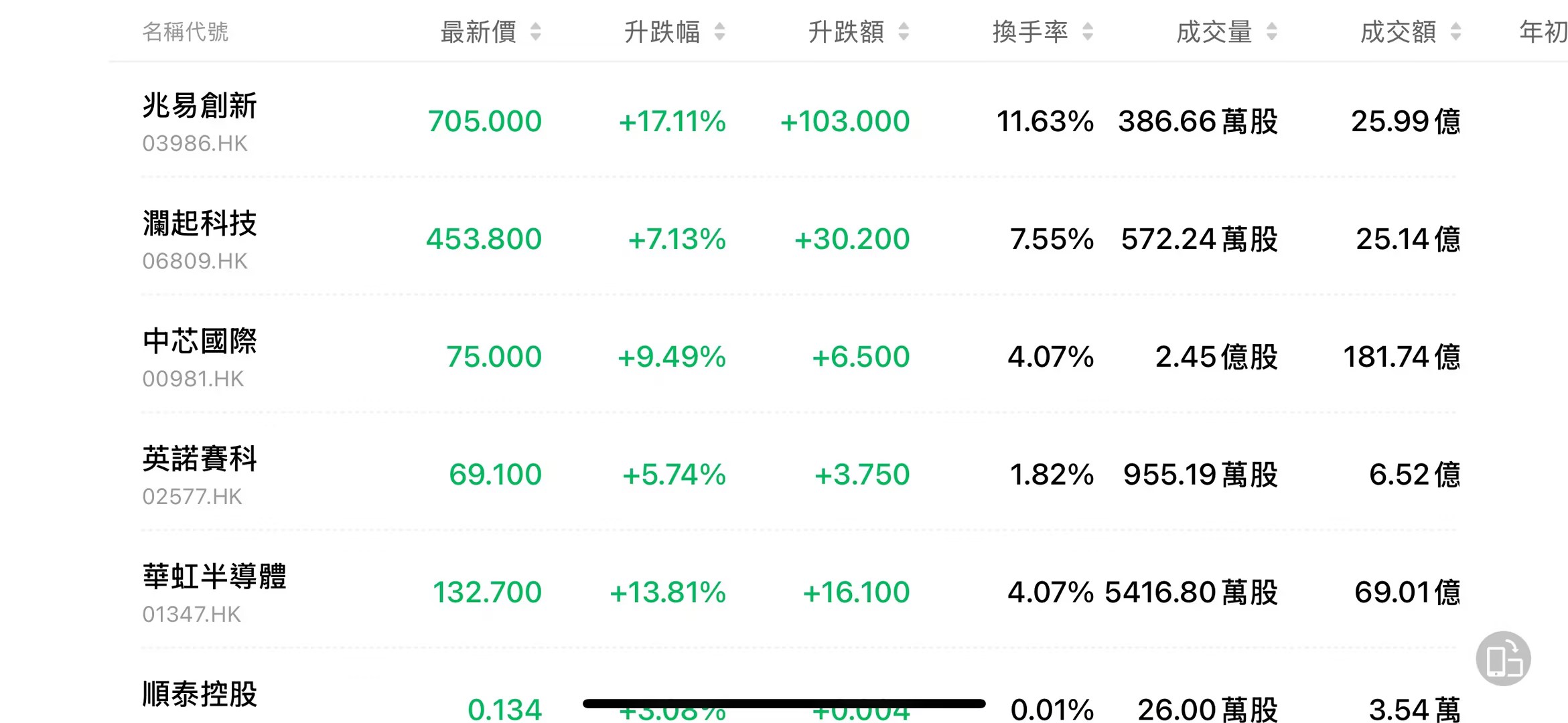
(Image source: uSMART HK app)
YMTC Launches IPO Counseling Process, Boosting Attention on the Memory Sector
According to disclosures published on the official website of the China Securities Regulatory Commission, Yangtze Memory Technologies Co., Ltd. has completed filing for IPO counseling registration, marking the formal launch of its A-share listing process.
As one of China’s leading memory chip manufacturers, YMTC has continued advancing technology upgrades in the NAND Flash segment in recent years. Public information shows that its wholly owned subsidiary, Yangtze Memory Technologies, was previously valued at approximately RMB160 billion and ranked among the companies included in the “2025 Global Unicorn List,” making it one of the world’s most highly valued semiconductor unicorns. The latest IPO filing has further strengthened investor focus on China’s domestic memory supply chain.
At the same time, discussions surrounding tightening supply conditions in the memory chip market have continued to intensify across the industry chain. Multiple media outlets, citing supply chain sources, reported that since the fourth quarter of 2025, manufacturers including YMTC and ChangXin Memory Technologies have experienced tight production schedules and strong order demand, with downstream customers reportedly required to lock in orders and capital commitments in advance to secure future supply allocations.
The market generally believes that growing demand from AI servers, data centers, and high-performance computing is driving a recovery in DRAM and NAND Flash demand, while also pushing the industry into a new upward pricing cycle.
AI Demand Drives Memory Price Recovery as Industry Fundamentals Improve
Several semiconductor companies have recently released increasingly optimistic signals regarding industry conditions. During a previous earnings conference call, SMIC management stated that the company has not yet observed a meaningful easing in the memory market, adding that demand growth from the AI industry has exceeded earlier expectations, while the pace of inventory normalization remains uncertain.
Institutions generally believe that this semiconductor cycle differs significantly from traditional consumer electronics-driven cycles, with AI computing demand emerging as the new core growth driver. As large language model training, inference workloads, and edge AI applications continue to expand, demand for high-bandwidth memory (HBM), advanced DRAM, and enterprise-grade SSDs has increased substantially.
According to publicly available research reports, following the mass production ramp-up of NVIDIA Corporation’s Rubin platform, next-generation AI architectures are expected to further increase demand for advanced memory, advanced packaging, and high-speed interconnect technologies. Meanwhile, technology giants including Google, Meta Platforms, Inc., and Amazon Web Services are accelerating ASIC chip iterations, further driving expansion in global computing infrastructure investment.
Against this backdrop, advanced packaging and memory technologies such as HBM4, Chiplet, CoWoS, and CoPoS continue to evolve rapidly, while expansion in advanced process capacity is also accelerating. This has further strengthened market expectations for improved industry conditions across semiconductor upstream materials, equipment suppliers, and wafer foundry segments.
Domestic Substitution Theme Strengthens; Upstream Material Suppliers May Continue Benefiting
Beyond memory chips themselves, market capital has recently begun paying closer attention to semiconductor materials and equipment suppliers.
Industry participants noted that China’s overall semiconductor material localization rate still has considerable room for improvement. Amid the ongoing push for supply chain self-sufficiency, domestic manufacturers are expected to benefit from rising demand in areas including silicon wafers, photoresists, electronic specialty gases, CMP materials, and advanced packaging materials.
As wafer fabs continue expanding capacity, advanced packaging penetration increases, and AI server demand grows, semiconductor industry capital expenditure is expected to remain elevated. Institutions believe that companies with technological breakthroughs and domestic substitution advantages across the materials, equipment, and memory supply chains may continue attracting market attention going forward.
From a capital flow perspective, investor focus on the AI hardware supply chain has gradually expanded beyond GPUs into segments including memory, advanced packaging, semiconductor materials, and wafer manufacturing. Against the backdrop of an ongoing global computing infrastructure investment cycle, market sentiment toward the semiconductor industry chain remains broadly constructive.
Follow us


More Content