Investment CoursesAI Bull Market Enters the “Bottleneck Era”: CPUs, HBM, and Optical Communications Are Defining the Next Major U.S. Equity Theme
Since May, U.S. AI-related stocks have continued to surge, with capital increasingly flowing toward the key “bottleneck” segments of the AI supply chain. According to the latest market data, as of publication, Advanced Micro Devices surged 11.44% to US$455.19, while NVIDIA rose 1.75% to US$215.20. In optical communications, Lumentum Holdings gained 1.26%, while the memory segment showed even stronger momentum: DRAM-related ETFs jumped 13.43% in a single session, and Micron Technology soared 15.49%, with trading volume approaching US$47 billion. Core AI infrastructure assets across the supply chain moved sharply higher.
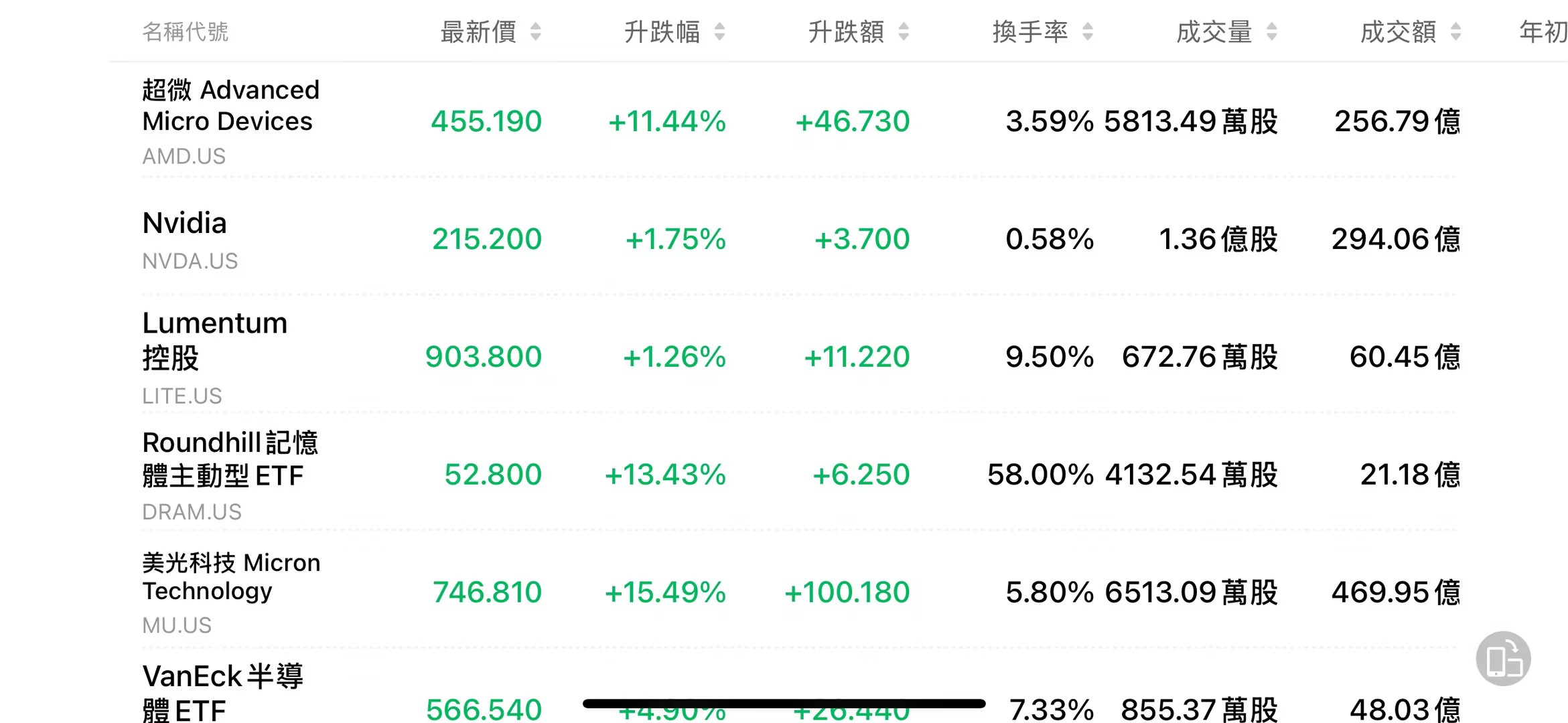
(Image Source: uSMART HK app)
The Rise of AI Agents: CPUs Regain Strategic Importance
Over the past two years, the AI rally has largely been driven by GPUs, with companies such as NVIDIA becoming the centerpiece of the computing boom. However, as Agentic AI rapidly evolves, the market is reassessing the strategic importance of CPUs.
Unlike traditional chatbot models, AI agents are designed to execute long-duration, multi-step tasks involving tool usage, data processing, and continuous reasoning. These workloads rely far more heavily on CPU orchestration and scheduling capabilities. Analysts at KeyBanc Capital Markets noted that the rise of agentic AI is materially increasing demand for server CPUs, bringing them back from a “supporting role” to the center of computing infrastructure.
This shift directly benefits companies such as Advanced Micro Devices and Intel. Meanwhile, NVIDIA is also expanding its CPU product lineup in an effort to build a more comprehensive data center ecosystem.
The market increasingly believes that AI infrastructure is transitioning from a “GPU-centric architecture” toward a new era defined by coordinated CPU, GPU, and networking systems.
HBM Becomes the Most Scarce AI Resource as Memory Enters a Supercycle
If CPUs serve as the scheduling hub, then High Bandwidth Memory (HBM) is rapidly becoming the scarcest resource in the AI supply chain.
The current HBM market is dominated by Samsung Electronics, SK hynix, and Micron Technology. As demand for AI model training and inference continues to surge, memory demand is growing far faster than manufacturing capacity.
Market data indicates that HBM capacity has already been booked well in advance, with some suppliers nearly sold out through 2026. At the same time, conventional DRAM markets are experiencing structural tightness as production capacity shifts toward HBM.
Demand for high-bandwidth memory from AI data centers is reshaping the entire memory supply chain, driving simultaneous upward revisions in both earnings expectations and valuations for related companies. Broader effects are also beginning to emerge, including rising storage costs filtering into consumer electronics pricing.
Optical Communications Become the Third Major Bottleneck as AI Interconnects Enter the “Photonics Era”
As AI clusters continue to scale up, pressure on data center interconnects has risen dramatically, pushing traditional electrical signal transmission closer to its physical limits.
Against this backdrop, optical communications have emerged as the third critical bottleneck in AI infrastructure. NVIDIA recently partnered with Corning to advance AI fiber-optic infrastructure. The company has also invested in optical networking firms including Coherent and Lumentum Holdings to accelerate the expansion of high-speed interconnect technologies.
Industry trends suggest that AI data centers are transitioning from electrical interconnects toward optical interconnect architectures. Technologies such as silicon photonics and Co-Packaged Optics (CPO) are moving rapidly toward commercialization.
Analysts believe that future AI computing bottlenecks will increasingly center on “how data moves at high speed,” rather than simply “how much compute power is available.”
How Long Can the AI Bull Market Last?
Wall Street remains broadly optimistic about the AI rally. Many institutions believe that AI investment has expanded beyond semiconductors into the broader infrastructure ecosystem, including computing chips, memory, optical communications, power infrastructure, and data center construction.
Some firms have even raised their targets for the S&P 500, citing stronger-than-expected corporate earnings growth and continued expansion in AI-related capital expenditures.
However, risk signals are also building. Investors including Michael Burry have warned that positioning in AI-related trades is approaching historically extreme levels, drawing comparisons to the dot-com bubble of 2000.
Some strategists also caution that as corporate capital expenditures continue to rise, cash flow pressure could gradually intensify, potentially leading the AI investment cycle into a more selective phase.
Nevertheless, based on the current supply-demand structure, the three major bottlenecks — CPUs, HBM, and optical communications — remain in a state of structural shortage with little sign of near-term relief. As a result, capital inflows into these AI “chokepoint” segments may continue to dominate the next phase of market leadership.


More Content