Market NewsEconomic growth remains steady, yet the sharp decline of the Vietnamese dong exchange rate raises questions.
On May 10th, the USD to Vietnamese dong exchange rate reached a historical high of 25,452. Last month, the USD to Vietnamese dong had already hit a new high of 25,365. This indicates an increasing trend of depreciation for the Vietnamese dong, setting new record lows. From the beginning of this year until May 10th, the Vietnamese dong has depreciated by around 3%, but compared to last year, the depreciation is close to 10%. The State Bank of Vietnam has intervened multiple times by selling USD to stabilize the currency, but the downward trend proves hard to stop.
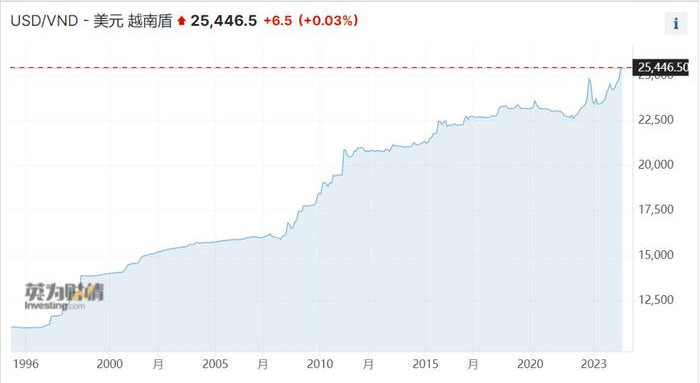 (Source:Investing.com,2024.05.10)
In addition to the plunge of the Vietnamese dong, the local Vietnamese media reported that since 2023, the total investment of international capital in Vietnam has declined by nearly 30%, with over 1 trillion Vietnamese dong in capital leaving the country. Analysts believe that in the past few years, due to the Federal Reserve's massive "money printing", the influx of US dollars has promoted Vietnam's economic development. However, as the U.S. increases its interest rate hikes, international capital has started to withdraw from Vietnam, leading to a large-scale outflow of capital.
What is the root cause behind the sharp depreciation of the Vietnamese currency?
Benefiting from improved capital mobility, the "diversification" of global supply chains, and the economic recovery in the surrounding regions, Vietnam's economic landscape looks good. However, why is the Vietnamese dong plunging? There are mainly four reasons:
· Financial crisis causing market turmoil and fiscal depletion
The State Bank of Vietnam had to rescue Saigon Commercial Bank (SCB), which was embroiled in a financial fraud case, by injecting massive special loans. This has increased fiscal pressure and weakened the financial system. The bank run by depositors triggered a chain reaction, affecting Vietnam's real estate industry, corporate bond market, and stock market.
· Constrained by export structure and the US dollar situation
Vietnam is highly dependent on the United States as its largest export destination. However, due to the expected slowdown in economic growth and the U.S. preference for "regular goods", the Vietnamese dong had to depreciate to maintain export competitiveness. This has led Vietnam to face exchange rate issues, requiring a balance between exports and economic stability.
· Discrepancies with the U.S. attitude
There are differences between the U.S. and Vietnam in terms of policies and attitudes. For example, although the Biden administration has declared that the two countries are comprehensive strategic partners, there are contradictions in identity recognition and trade policies. Vietnam hopes to be recognized as a "market economy", but the U.S. authorities are cautious about this. The "non-market economy" label means that some of Vietnam's export products will inevitably face "anti-dumping tax investigations" by the U.S., implying higher tax rates on Vietnamese products.
· Excessive reliance on foreign capital
To attract foreign investment, Vietnam has implemented very favorable investment policies, welcoming foreign capital regardless of size. This has led to an extremely high dependence of Vietnam's economy on foreign capital, with foreign direct investment accounting for up to 49.2% of total fixed asset formation (source: Netease article). This over-reliance on foreign capital makes Vietnam's economic policies easily influenced by external factors, such as capital outflows or fluctuations, which can have a significant impact on the Vietnamese dong exchange rate.
The frequent upheavals caused by the US dollar hegemony, Vietnam's crisis may lie within its economy internally.
The sharp drop in exchange rates is not just a problem faced by Vietnam alone.
The sustained strength of the US dollar has led to significant depreciation of several countries' currencies in recent times. As reported by the media on May 8th, the South Korean won has depreciated by over 5.5% against the US dollar this year, becoming one of the worst-performing currencies in Asia. By May 11th, the Japanese yen, Thai baht, Indonesian rupiah, and other Asian currencies also experienced sharp drops—the yen even briefly breaking below the 160 mark against the US dollar, hitting a 34-year low.
Export-driven commodity economy is a vital component of Vietnam's economy, heavily reliant on commodity exports. In recent years, the rise of "Made in Vietnam" has sparked discussions about Vietnam potentially replacing China as the world's new factory. However, while foreign giants have propelled the development of Vietnam's manufacturing industry, they have also accelerated Vietnam's domestic industry's external dependence, severely impacting the growth of local businesses. Benefiting from advantages like labor costs, Vietnam has reaped the rewards of contract manufacturing, leading to booming export trade. Nevertheless, the domestic industrial capabilities have not completely kept pace.
The record-low Vietnamese dong exchange rate may be a cyclical issue driven by market fluctuations, but the real crisis could stem from within the economic structure: the lack of strength and core competitiveness in local industries.


More Content