Investment CoursesSurge in Deliveries Boosts Market Confidence as New Energy Vehicle Manufacturers Enter the "Golden October" Market Surge
In October, the Chinese new energy vehicle (NEV) market experienced a strong "Golden October," with mainstream new energy car manufacturers posting impressive delivery numbers, signaling a continued recovery in market demand.
Li Auto stood out with a remarkable performance, surpassing 50,000 units in monthly deliveries, a year-on-year increase of approximately 20%, maintaining its lead in the high-end new energy segment. XPeng Motors delivered over 20,000 vehicles, marking a significant increase from the previous month. The hot sales of models such as the G9 and the new MONA M03 were key drivers. NIO's deliveries reached about 18,000 vehicles, maintaining steady growth with the support of product line optimization and the continuous expansion of its battery swap network.
Meanwhile, Leapmotor, following its strategic partnership with Stellantis, accelerated its overseas expansion, achieving a robust year-on-year growth of over 40% in deliveries. Xiaomi Motors, still in its early stages of large-scale deliveries, has seen high demand for its models, laying a solid foundation for future brand popularity and market share.
Hot New Energy Vehicle Stocks Surge, Market Sentiment Recovers
After the release of October delivery numbers, the first trading day saw a strong rebound in the stock prices of new energy vehicle manufacturers. On the morning of November 3, Li Auto closed at ¥80.20, up 0.56%; XPeng Motors closed at ¥90.00, up 3.21%; and NIO closed at ¥56.05, up 2.66%. Leapmotor and Xiaomi Motors also performed well in the stock market. Overall, the stock prices of these companies reflect investor confidence in the industry's outlook, with funds flowing back into the new energy vehicle sector and market sentiment noticeably recovering.
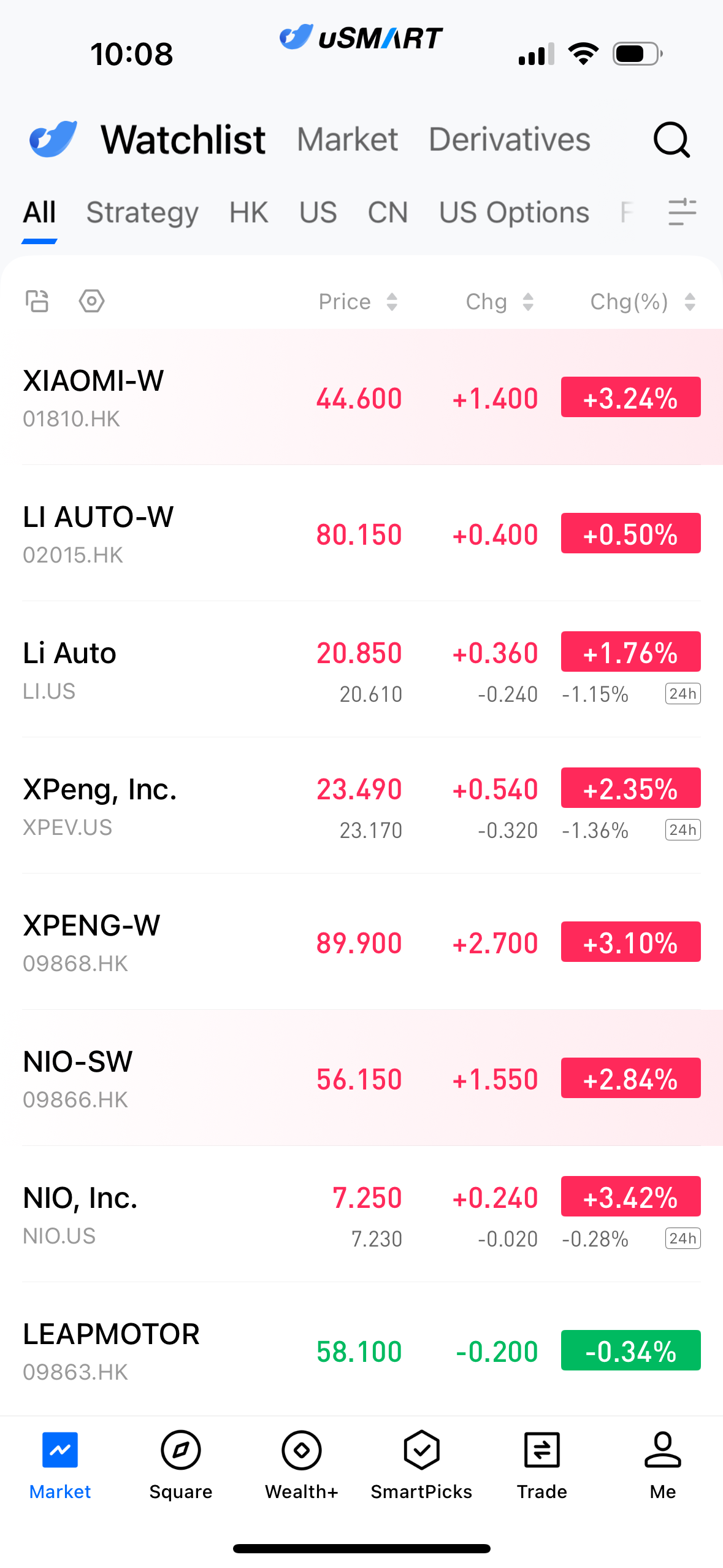 (Image source: uSMART HK app)
Continued Government Support Boosts Industry Confidence
Government policies continue to provide strong support for the industry. Recently, the Ministry of Industry and Information Technology (MIIT) reiterated its plan to promote "new energy vehicles to the countryside" and optimize purchase subsidies to drive NEV adoption in lower-tier cities. Local governments have also increased their support for charging stations and battery swap infrastructure, improving long-term growth expectations for the industry.
At the same time, the decline in battery material prices has further lowered vehicle production costs, providing room for improved profitability for carmakers. With a combination of policy support, technological progress, and cost control, the market confidence of NEV manufacturers has steadily recovered, and the industry's outlook remains positive.
Accelerated Overseas Expansion and Technological Innovation Become New Competitiveness
As competition intensifies in the domestic market, many automakers are accelerating their international expansion. Li Auto plans to officially enter the European market by 2026, XPeng Motors has already set up sales and service outlets in several European countries and begun deliveries of new models. NIO is also speeding up the expansion of its battery swap network in Europe to meet international demand. Leapmotor, through its collaboration with Stellantis, is rapidly expanding into international markets to enhance its global competitiveness.
On the technology front, competition is becoming more sophisticated. Li Auto continues to focus on extended-range electric vehicle (EREV) technology, while XPeng and NIO are focusing on smart driving technology and high-performance chips. Xiaomi Motors is making significant strides in developing its own smart cockpit and AI driving technologies, aiming to lead in intelligent features. Technological innovation is becoming the core of competition in the future, and differentiation is gradually shifting from hardware to intelligent and digital development.
Optimistic Market Outlook, Continued Growth for New Energy Vehicles
As the year-end car-buying season approaches, demand for new energy vehicles is expected to remain strong. Industry experts are generally optimistic about the performance in the fourth quarter, predicting that leading companies will continue to benefit from policy incentives and consumer recovery, with sales increasing further. On the macroeconomic level, as global monetary policies stabilize, NEV manufacturers are likely to enjoy a more favorable capital market environment. In the medium to long term, as the penetration rate of NEVs in the domestic market continues to rise and global demand expands, the NEV industry remains in a structural growth phase. Technological innovation and international expansion will be key to gaining market share for automakers.


More Content